
Burnout has become one of the defining challenges facing modern healthcare systems.
Clinicians and healthcare staff are increasingly expected to manage growing documentation requirements, expanding digital communication channels, and complex administrative workflows, often alongside rising patient demand.
While the causes of burnout are multifaceted, research consistently points to a set of recurring pressures: time spent in electronic health records, after-hours documentation, administrative tasks unrelated to patient care, and the growing volume of alerts and patient messages that clinicians must review each day.
To support, enter AI.
Artificial intelligence is beginning to reshape how healthcare organizations address these challenges. New tools, from ambient AI scribes to automated communication systems, are designed to reduce administrative workload, streamline workflows, and help clinicians focus more of their time on direct patient care.
Below are five of the most significant drivers of burnout in healthcare in 2026, and how emerging AI technologies are beginning to address each one.
Five Areas Where AI Is Beginning to Reduce Burnout In Healthcare
1. Documentation Time and After-Hours Charting
Administrative documentation remains one of the largest contributors to physician burnout. Writing clinical notes, updating records, and completing EHR tasks often extend beyond patient appointments and into evenings and weekends.
AI documentation assistants and ambient AI scribes are designed to reduce this burden by automatically capturing conversations, generating structured notes, and integrating documentation into the EHR.
Studies show these tools can significantly reduce the time clinicians spend writing notes and interacting with the EHR. For example, a cohort study comparing 125 clinicians using an ambient AI scribe to 478 controls found that clinicians using the tool spent significantly less time in the EHR and less time writing notes per appointment while also improving encounter closure time.
Similarly, researchers at UChicago Medicine found clinicians using an ambient AI documentation tool spent 8.5% less total time in the EHR and more than 15% less time composing notes, saving multiple hours each week.
Other research suggests AI documentation assistants may reduce the time physicians devote to documentation by up to 70%, helping clinicians complete notes during the visit rather than finishing charts late at night.
By reducing documentation workload and after-hours charting, AI scribes can help clinicians reclaim time and improve work-life balance.
2. Cognitive Load and Mental Fatigue in Clinical Work
Reducing documentation can also have a measurable impact on clinician well-being. As administrative tasks decrease, clinicians are able to spend more time focusing on patients rather than managing paperwork.
In a multicenter quality-improvement project involving 263 clinicians, the use of an ambient AI scribe reduced reported burnout from 51.9% to 38.8% within 30 days, representing a 74% reduction in the odds of experiencing burnout. The same study also found significant reductions in administrative burden and cognitive task load, with clinicians reporting a greater ability to concentrate on patient care during appointments.
By reducing both time pressure and mental workload, AI scribes can help address some of the key factors contributing to clinician burnout.
3. Non-Clinical Administrative Work and Revenue Tasks
Burnout isn't driven by clinical work alone. A significant portion of physician stress comes from non-clinical administrative tasks such as billing, coding, insurance claims, and bookkeeping. A Canadian study found that physicians spend an average of 7.5 hours per week on non-clinical administrative work.
AI tools are increasingly being used to automate these back-office processes.
In revenue cycle management (RCM), AI can assist with medical coding, automate claim submissions, and detect errors before claims are sent to insurers.
For example, Claio can analyze a SOAP note and automatically suggest ICD-10 diagnosis codes, allowing clinicians to confirm codes quickly instead of manually searching through coding references.
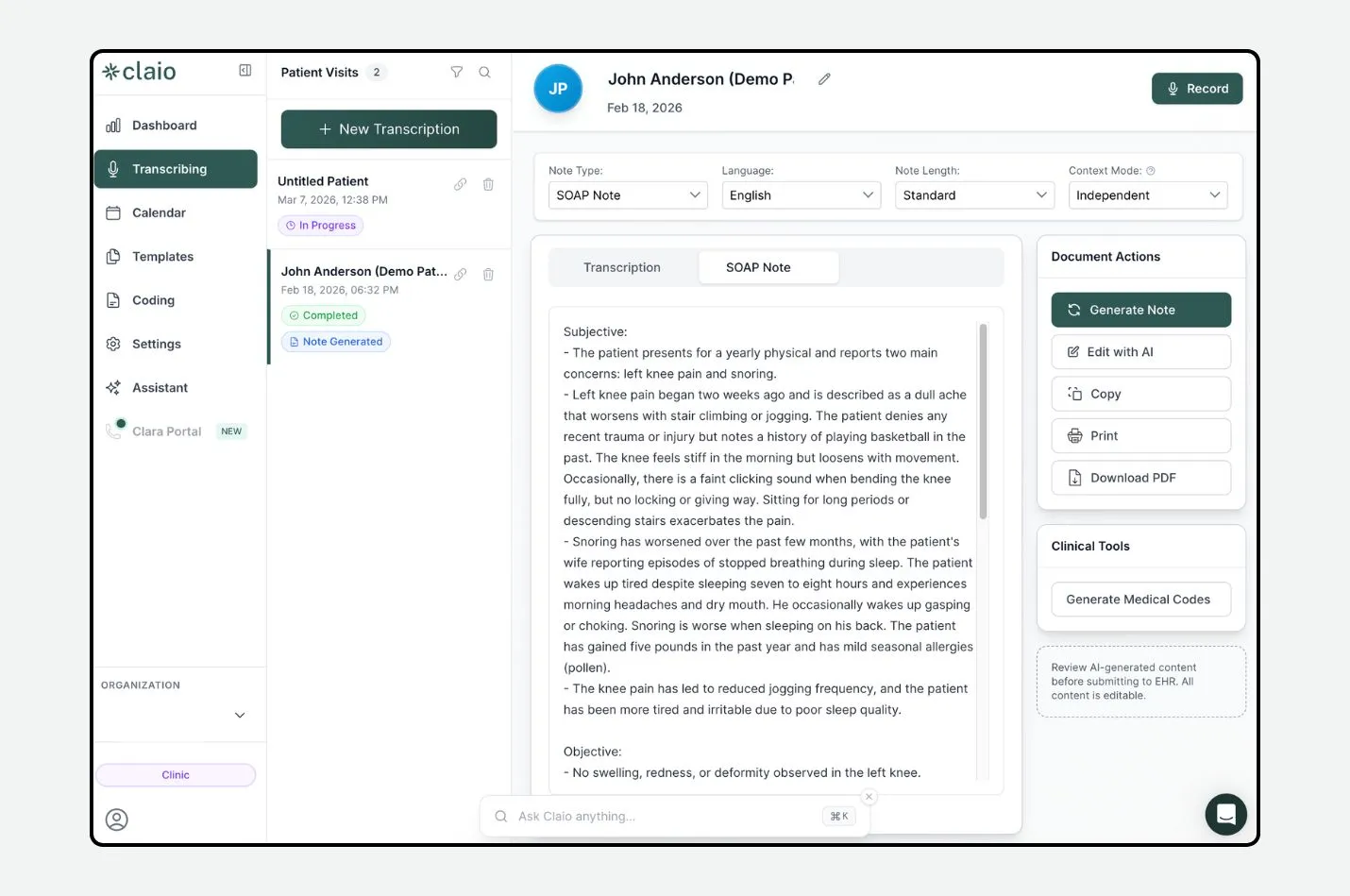
This type of automation helps reduce the time physicians and clinic staff spend on billing-related tasks while improving documentation accuracy.
4. Alert Fatigue from Remote Monitoring
As remote patient monitoring becomes more common, clinicians often need to review a high volume of device alerts and patient data transmissions. Many of these alerts are routine or low-priority, creating alert fatigue and adding to clinicians' workload.
AI-assisted monitoring systems are beginning to address this challenge by automatically filtering routine transmissions and highlighting only alerts that require clinical attention.
In one study examining AI-assisted monitoring for cardiac implantable electronic devices, AI-based filtering reduced unnecessary alert reviews and lowered annual clinician workload per patient by 42%.
The same workflow pre-filters device transmissions and automates routine review steps, allowing clinicians to focus on a smaller subset of abnormal alerts and potentially shortening the time to clinical evaluation.
By prioritizing the most important signals and filtering out routine alerts, AI-driven monitoring systems can reduce cognitive overload and improve clinician efficiency.
5. Front Desk Communication and Scheduling Workload
Another growing source of workload in healthcare comes from front-desk communication tasks such as answering calls, scheduling appointments, and responding to routine patient questions. These responsibilities require constant multitasking, frequent interruptions, and the ability to manage high patient demand.
Burnout among non-clinical healthcare staff is also a growing concern. A study of healthcare administrative workers found an overall burnout rate of 45.6%, with roles such as medical receptionists identified as particularly vulnerable due to high-pressure environments and long working hours.
The intensity of the role is often reflected in real-world experiences. As one medical clinic receptionist told BBC News, "when the phone lines open, it just goes manic."
AI front desk tools are beginning to help manage these communication demands. These systems can answer patient calls, schedule appointments, send reminders, and respond to routine questions without requiring manual staff intervention.
For example, Claio's Clara AI is an AI-powered front desk assistant that can answer calls 24/7, automatically schedule appointments, and manage routine patient communication.
By handling many common front-desk interactions, AI assistants can reduce interruptions for clinic staff while ensuring patients still receive timely responses.
AI Is Reshaping the Operational Burden of Healthcare
Modern clinicians and healthcare staff now operate within highly digitized environments that generate vast amounts of documentation, alerts, messages, and administrative tasks. In many cases, the challenge is not the practice of medicine itself, but the growing operational workload that surrounds it.
Artificial intelligence is beginning to shift that balance.
Rather than adding yet another layer of technology, many AI systems are designed to support clinical and non-clinical staff by capturing documentation automatically, filtering unnecessary alerts, triaging patient communication, and handling routine administrative tasks.
When implemented thoughtfully, these tools are not intended to replace healthcare teams or roles. Instead, they aim to reduce the operational friction that has accumulated across modern healthcare workflows, allowing healthcare professionals to spend more time, attention, and energy on the work that matters most.
Where Claio Fits
Claio provides AI-powered tools that help healthcare teams automate documentation, coding, and front-desk communication. Learn more about how Claio can help reduce administrative workload in your practice.
- Insights
- Productivity
Published by the Claio team